

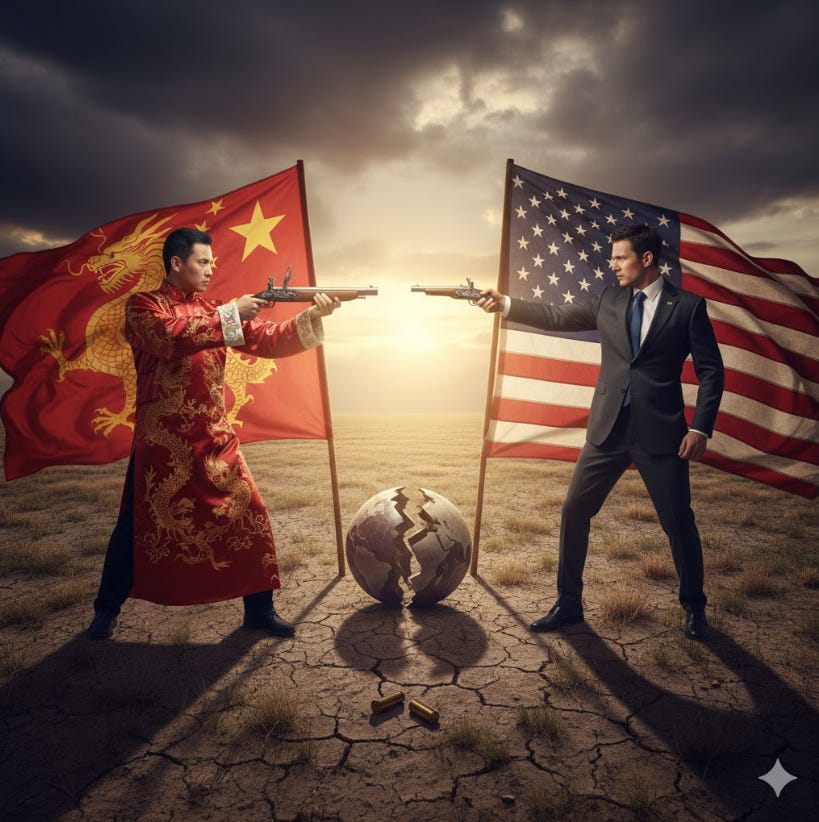
On October 9, the trade war between China and the U.S. suddenly intensified with an announcement from the Chinese Ministry of Commerce introducing stricter export controls on rare earth materials. These restrictions would now require companies to obtain licenses from the Chinese government to ship any product containing even trace amounts of rare earth elements overseas. The next day, the Trump Administration responded with a threat to impose a tariff increase of 100% on all Chinese imports beginning Nov. 1 if Beijing refuses to back down. The dual announcements sent U.S. stock markets reeling, dumping $2 trillion worth of equities in one day.
The Ant and the Grasshopper
What makes rare earths so special, and so geo-stratigically important, is not that they are rare per se, but that they represent a bottleneck in the global supply chain for advanced technologies. Over the past two decades, China has quietly built up its infrastructure to mine and process these minerals and has acquired assets through subsidiaries in Africa and South America with the intent of dominating the global rare earth market.
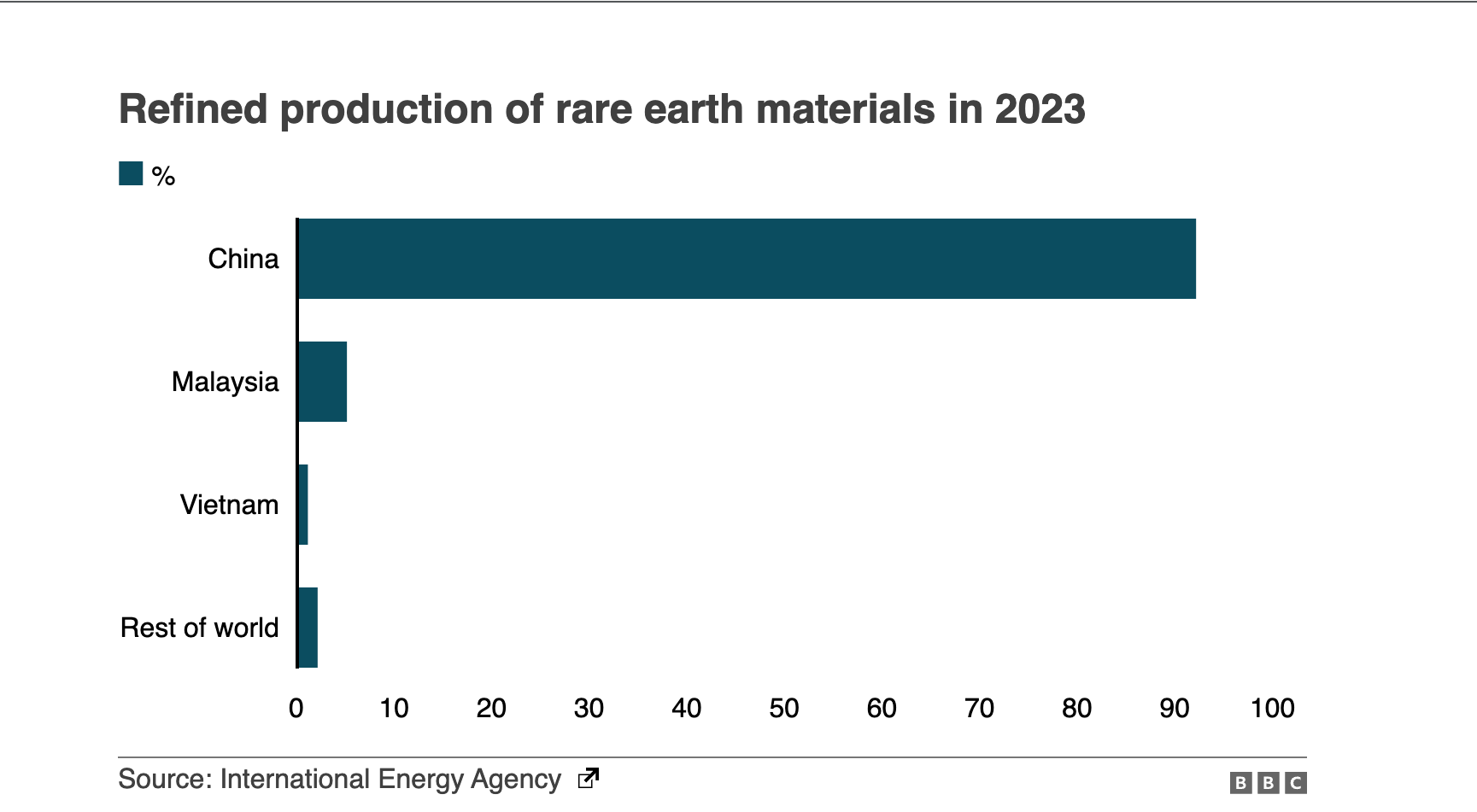
The Chinese have been remarkably successful in this endeavor. The result is a vertically-integrated business model, where the entire process from extraction to refining is controlled by Chinese companies and, by extension, the command economy of President Xi Jinping and the Chinese Communist Party. According to the International Energy Agency (IEA), the People’s Republic of China (PRC) produced 92% of the world’s refined rare earth materials in 2023:
Collectively, rare earths refer to a group of 17 metallic elements that are chemically similar and tend to cluster together in the earth’s crust. Rare earths are highly coveted for their electrical conductivity, luminescence, and magnetic properties, which makes them essential in applications such as semiconductors, lithium-ion batteries, LED lighting, and industrial processing for materials such as glass and ceramics. Some well-known examples include Neodymium, used to power the magnets in wind turbines and consumer products such as Apple Airpods, and Ytterbium, used in lasers, atomic clocks, and fiber optic cables.
Although these minerals are actually quite abundant on a parts per million basis, they appear as trace elements fused together in composite materials that are very difficult to separate and purify. China has continued to consolidate control over the industry with very little competition in large part because it has fewer regulations and less concern overall than Western countries regarding the impacts to human health and the environment resulting from a notoriously dangerous and dirty refining process. The U.S. and Europe have been historically apprehensive to build their own network of refineries, due to the risks to workers exposed to toxic chemicals during the separation process, and due to potential environmental pollution from effluent materials, including heavy metal leaching and radioactive contamination.
The escalating tensions between the PRC and the U.S. thus creates a precarious situation, not only for America, but for all developed nations dependent on Chinese rare earth products to manufacture the technologies powering the modern world. Companies seeking authorization from China to export rare earths will now be subject to case-by-case reviews for each permit, potentially requiring lengthy technical documentation and intended use cases for every type of advanced semiconductor or Neodymium magnet component. This gives China significant leverage to delay or restrict the number of licenses issued for each technology, further manipulating the high-tech market to suit its strategic political and national security agendas.
Moreover, permits to acquire rare earths for express military purposes will be almost unilaterally denied. As Gracelin Baskaran, director of the Critical Minerals Security Program at the Center for Strategic and International Studies (CSIS) stated; “Under the new rules, starting December 1, 2025, companies with any affiliation to foreign militaries—including those of the United States—will be largely denied export licenses.” Such a prohibition would seriously impact the U.S. ability to build critical defense systems, such as F-35 fighters, Tomahawk missiles, and Predator unmanned aerial vehicles, which all depend on rare earths from China.
Patience, Grasshopper
Now, with so much time and so many resources frittered away, what can the U.S. do to counter China so late in the game? One option is to establish bi-lateral agreements with cooperative countries to check the PRC’s ability to buy up remaining rare earth resources. For example, earlier this month, President Trump unveiled a deal with Australia worth $8.5 billion to inject capital into that country’s rare earth mining technologies. Australia holds the fourth largest rare earths reserves in the world, and is currently the top global destination for securing undeveloped mines. It is therefore crucial for the United States to form meaningful trade and development partnerships with Canberra to accelerate its capacity to both extract and refine products to serve as an alternative supply chain to China. Some analysts also speculate that Trump’s intent to increase U.S. presence in Greenland is highly linked to the wealth of rare earths hidden under the ice of the Danish landmass.
In the longer term, the U.S. has very little choice but to develop its own refineries. Some small scale operations have already begun commercial rare earth refining, such as Pheonix Tailings in Massachusetts, and a Department of Energy demonstration site in Wyoming. However, the U.S. still lags far behind China, and has little hope of catching up without prioritizing industrial policy to support the refining of rare earths products. Expert analysts suggest an approach focusing on 1) reducing red tape and expediting permitting to open U.S. -based mines and refineries and 2) setting up public-private partnerships between companies and the federal government to create centralized refining hubs where resources, equipment, and technologies can be shared among all parties to accelerate growth and streamline supply chain and delivery processes.
However, even with dedicated industrial policy, bi-partisan buy-in for such a plan will be almost impossible without assurances about worker safety and contamination prevention. Addressing the environmental risks of domestic refining is ultimately key to breaking China’s stranglehold over the industry. To this end, it is critical that federal agencies such as the Department of Energy and the Department of Defense continue to fund university and industry research and development aimed at cleaning up dirty refining processes and mitigating contamination risks. Some basic research in this area has already been published. Studies at the University of California, Santa Barbara have produced a novel method to purify rare earths at room temperature without the need to use toxic and caustic chemicals. Other major universities, such as Harvard, Cornell, and Penn State have also made promising breakthroughs in new techniques to make the processing of rare earths more environmentally friendly.
A Murky Path Ahead
This weekend, a U.S. delegation led by Treasury Secretary Scott Bessent and Trade Representative Jamieson Greer heads to Malaysia to participate in talks with the PRC and the Association of Southeast Asian Nations (ASEAN). The junket will likely culminate in a meeting between President Trump and President Xi next week in South Korea. On the top of the agenda undoubtedly will be tariffs and rare earths. For the time being, there is enormous pressure on both sides to keep a modicum of trade flowing, especially ahead of the holiday season. As Dennis Wilder, senior fellow at Georgetown University’s Initiative for U.S. -China Dialogue on Global Issues told Reuters, “Ultimately, I’m optimistic that at this particular meeting there will be tactical decisions to sort of extend the pause” of the tariffs and rare earth shipping restrictions. However, as tensions remain high, tempers flare, and the relationship between the two superpowers continue to fray, the trade war is only getting warmed up.
Whether it will be the U.S. or China to first call the other’s bluff remains to be seen.
Meanwhile, the world hangs in the balance.
Electrically yours,
K.T.
Thank you for this incredibly informative post. I feel significantly less ignorant in a few short minutes. Bravo
China plays the long game (50-100yrs). They take advantage of weak, corrupt leaders all around the world and "invest" billions for infrastructure, ports, coal, oil and minerals. They refine them in these countries as far as the infrastructure and skills will allow. And then refine every metal in their country with no regulations and no concern for safety or human rights (ie.no unions, congress or legal system.) They make maximum use of internal "slave" labor, Uyghurs, Turks and Falun Gong.
Conversely, the "civilized world" has red tape everywhere, resistance from society writ large, elections at every step, lawfare, battling factions and violence in cities, completely failed illegal immigration system etc. Also, an education system that seeks new lows in the world, where Tik Tok, Instagram, You Tube and other social media dominate our lives. And the absolutely false specter of "net zero" pushed for at least thirty years, where plant food is demonized. All with the assistance of our once prestigious, public institutions in government and universities to say nothing of billionaire and trillionaire ENGO's.